3 Ways Resistance Shows Up in Schools (That Leaders Misread)
Apr 03, 2026
There are moments in schools that pass by quickly and often unnoticed.
A team nods along during a meeting and it feels like alignment has been reached.
A teacher offers, “We’ve tried that before,” and the conversation shifts direction.
A classroom visit shows the strategy in place, but disappears when no one is watching.
Nothing about these moments feels urgent. They rarely interrupt the flow of the work. So the meeting continues and the plan gets reinforced. The assumption is that things are moving forward.
I have moved through those moments more times than I can count. At one point, I would have told you that was good leadership. Stay focused, keep momentum, and respect people’s time.
That interpretation started to feel incomplete.
Certain moments stayed with me after the meeting ended. Not the loud ones. with the obvious pushback. It was those quieter moments. The ones that felt easy to move past. Over time, a pattern began to emerge. These moments were not small. They were signals.
Resistance was present in those interactions. It simply was not showing up in a way that made it easy to name.
It rarely presents as open defiance. It tends to show up in ways that sound reasonable, even cooperative, which makes it easy to misread in real time.
Three patterns that I have experienced repeatedly show up consistently across schools.
1. The “Agree and Stall” Pattern
On the surface, it sounds like alignment.
“This makes sense.”
“Yeah, I can do that.”
“Absolutely.”
The meeting ends with a sense of progress. There is relief in how smoothly it went. It feels like everyone is on the same page.
A few weeks later, the work looks largely the same.
There is little evidence of follow-through. Instruction has not shifted in a meaningful way. The energy from the meeting does not translate into action.
That gap can feel confusing at first.
Agreement creates the appearance of movement, yet it offers very little information about what someone is actually ready to do. It signals willingness in the moment, not commitment over time.
Underneath that quick yes, there is often something unresolved. The value may not feel strong enough to prioritize. The next step may not feel clear or doable. The belief that it will lead to success may not be there yet.
In those moments, people choose the path that preserves their energy and their sense of competence. Agreement becomes the safest response.
When agreement is taken at face value, the hesitation underneath it goes unnoticed.
2. The “That Won’t Work Here” Pattern
This one often sounds like professional judgment.
“Our kids are different.”
“We’ve tried that before.”
“That might work somewhere else.”
The tone can be calm. The statement can feel grounded in experience.
Sometimes it is.
Other times, there is more sitting underneath those words than it initially appears.
There is history. Previous initiatives that did not lead to results, moments where effort did not pay off, and a growing skepticism about whether change will actually make a difference in this specific context.
There is also identity. Educators develop a strong understanding of their students and their environment. That identity becomes part of how they interpret any new approach.
When a strategy feels misaligned with that identity, resistance shows up as a protective response.
The instinct is often to respond with more explanation. Leaders provide examples. They clarify the research. They attempt to show that the strategy can work.
That response addresses the surface of the statement, not the belief underneath it.
What sits below the words is often doubt about success in this context. Until that belief is addressed, the strategy remains at a distance.
3. The “Perform for Compliance” Pattern
This pattern is the most deceptive.
At a glance, it looks like success.
The strategy is visible during a classroom visit.
The expected structures are in place.
The data appears to reflect implementation.
There is a sense of reassurance in seeing the work show up.
A closer look tells a different story.
The implementation lacks depth. It appears during observation and fades afterward. The work is present, though it does not feel owned or internalized.
This is what happens when the primary driver is external accountability rather than internal belief.
Educators respond to what is being measured. They meet expectations in visible ways. The focus shifts toward doing what is required, rather than engaging in meaningful change.
Over time, the gap between appearance and impact becomes more noticeable.
What looks like progress is often compliance.
When attention stays on what is visible, the underlying disconnect remains untouched.
Why this matters
All of these are forms of resistance.
They do not need to be eliminated. They need to be understood.
Each pattern points to something underneath the behavior. A belief that has not been established. A risk that feels too high. A lack of clarity about what success looks like. A question that has not been fully answered.
The pace of school leadership often pushes toward quick interpretation and quick response. That pace makes it easy to react to what is visible and move on.
A different approach starts with noticing. It requires a pause long enough to consider what might be driving the moment.
That shift changes the response. It also changes what becomes possible next.
A question to take with you
As you move through your next meeting, coaching conversation, or classroom visit, notice the moment that would normally pass by without much thought.
Stay with it for a few seconds longer than usual.
What kind of resistance might be showing up, and what might be driving it?
That question opens the door to a different kind of response.
That is where progress begins.
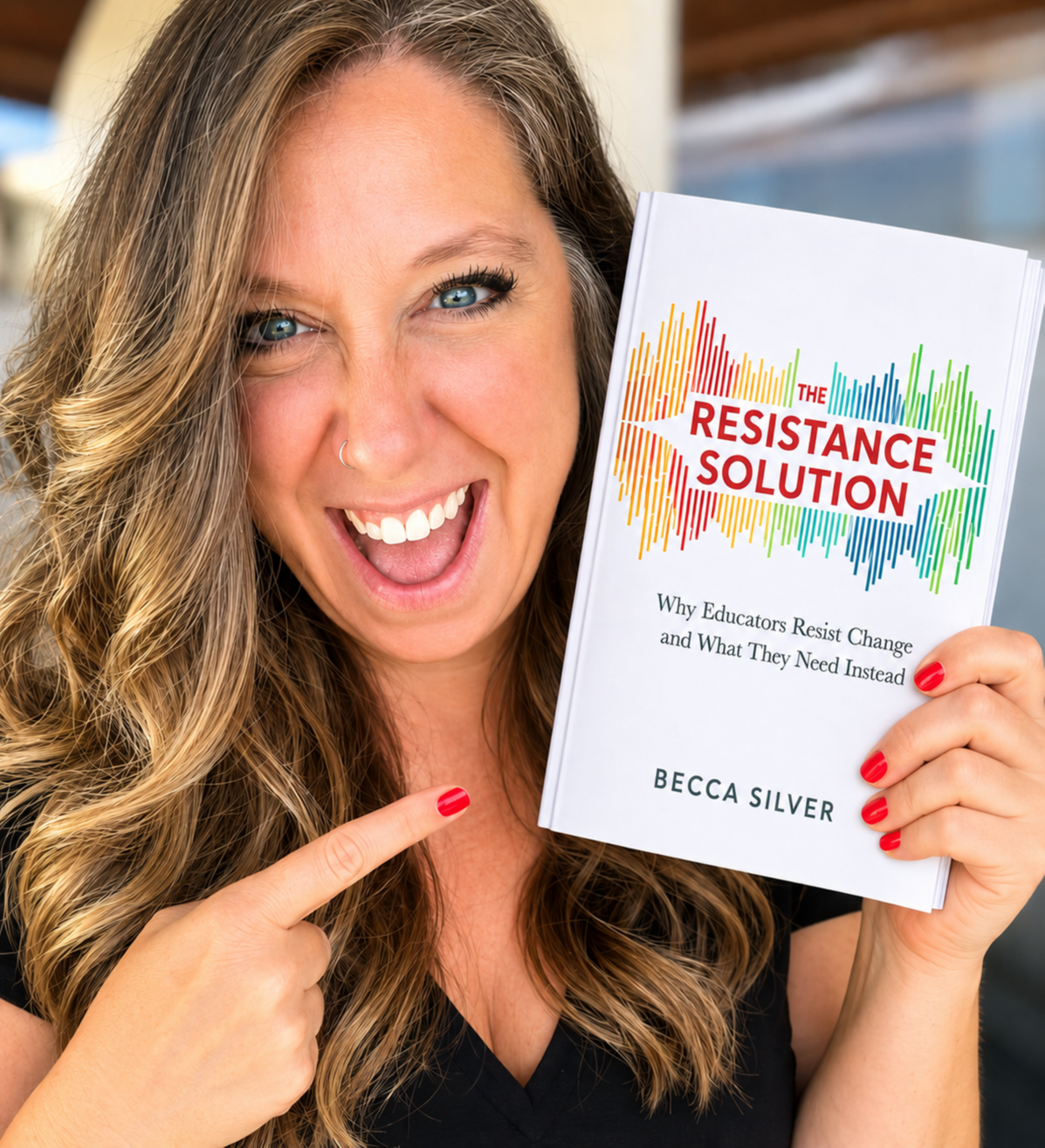
WANT TO DIVE DEEPER IN THIS WORK? Grab my book, The Resistance Solution !
What’s really causing the resistance?
You’re seeing the pushback, the hesitation, the lack of follow-through. This quick audit helps you pinpoint what’s actually underneath it so you can respond in a way that works.
Stay connected with news and updates!
Join our mailing list to receive the latest news and updates from our team.
Don't worry, your information will not be shared.
We hate SPAM. We will never sell your information, for any reason.